
Best Lawn Fertilizer Schedule for US Homeowners
The best lawn fertilizer schedule is not the same for every US homeowner because grass type, regional climate, soil condition, and seasonal growth cycles directly affect when nutrients work best. Fertilizing too early, too often, or during heat stress can waste product, weaken roots, and create uneven lawn growth.
A strong fertilizer plan matches application timing with active grass growth, soil needs, and real weather conditions instead of following a fixed calendar blindly. This blog explains how homeowners can build a practical lawn fertilizer schedule that supports thicker growth, better color, and long-term turf health.
The Best Lawn Fertilizer Schedule Depends on Grass Type First
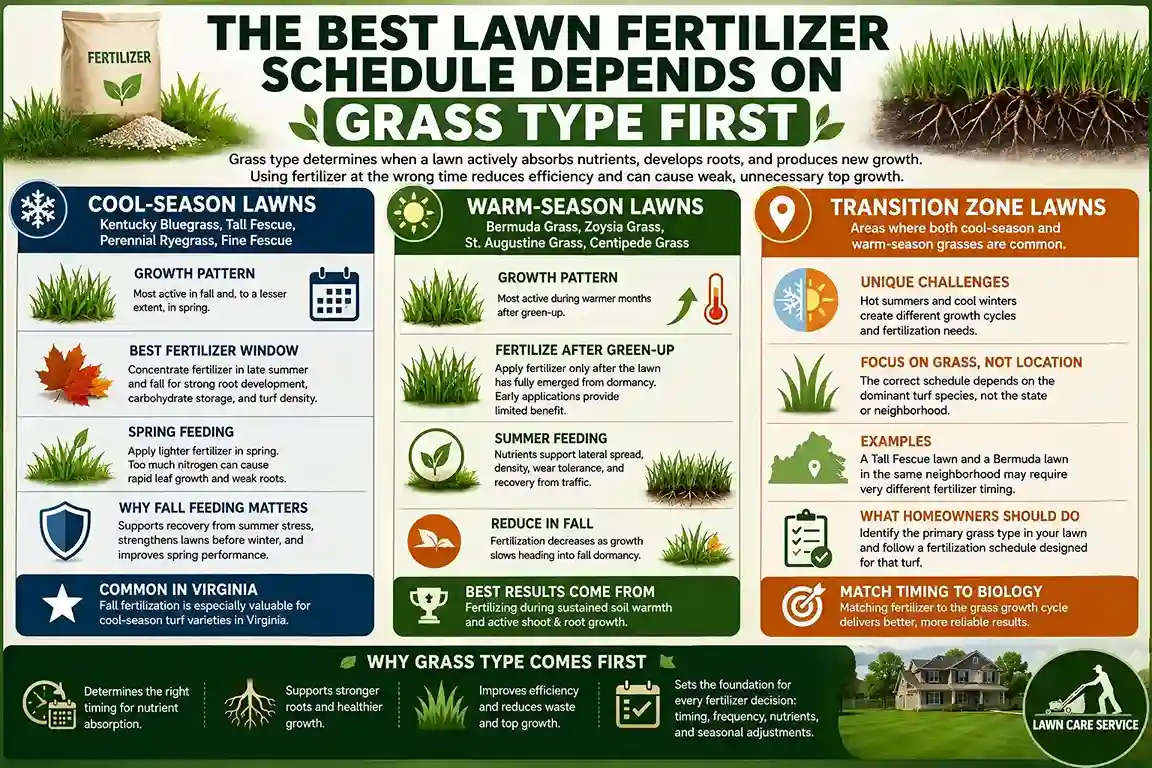
Grass type determines when a lawn actively absorbs nutrients, develops roots, and produces new growth. Applying fertilizer outside a grass’s primary growth period reduces nutrient efficiency and can encourage weak or unnecessary top growth. Before choosing a fertilizer calendar, homeowners should identify whether their lawn contains cool-season or warm-season turf.
How Should Cool-Season Lawns Be Fertilized Throughout the Year?
Cool-season grasses such as Kentucky bluegrass, tall fescue, perennial ryegrass, and fine fescue grow most actively when temperatures are moderate. Their strongest growth periods occur during fall and, to a lesser extent, spring.
Most fertilizer applications should be concentrated in late summer and fall because this is when these grasses prioritize root development, carbohydrate storage, and turf density. Fall feeding supports recovery from summer stress and prepares the lawn for winter dormancy. Spring fertilization is typically lighter because excessive nitrogen can stimulate rapid leaf growth at the expense of root development.
Homeowners in Virginia commonly maintain cool-season turf varieties, making fall fertilization particularly valuable for strengthening lawns before winter and improving spring performance.
How Should Warm-Season Lawns Be Fertilized Throughout the Year?
Warm-season grasses such as Bermuda grass, zoysia grass, St. Augustine grass, and centipede grass perform best during warmer months. Their nutrient demand increases after green-up when active growth begins and continues through the summer growing season.
Fertilizer should generally be applied only after the lawn has fully emerged from dormancy. Early applications before green-up provide limited benefit because nutrient uptake remains low while growth activity is still restricted.
During summer, warm-season grasses can effectively use nutrients to support lateral spread, density, wear tolerance, and recovery from traffic. Fertilization typically decreases as growth slows heading into fall dormancy.
The most productive feeding window for warm-season turf aligns with sustained soil warmth and active shoot and root growth.
What Should Homeowners in the Transition Zone Do?
The transition zone includes regions where both cool-season and warm-season grasses are commonly used. States within this belt often experience hot summers and cool winters, creating unique fertilization challenges.
The correct schedule depends on the dominant turf species rather than geographic location alone. For example, a tall fescue lawn and a Bermuda lawn in the same neighborhood may require significantly different fertilizer timing.
This is especially relevant in areas such as Columbia and parts of Virginia, where climate conditions can support different turf types depending on local growing conditions and lawn management goals.
Homeowners should first identify the primary grass covering the lawn and then follow a schedule designed for that turf type. Matching fertilizer timing to the biological growth cycle of the grass produces more reliable results than following a generalized regional calendar.
Understanding grass type first creates the foundation for every fertilizer decision that follows, including application timing, frequency, nutrient selection, and seasonal adjustments.
Month-by-Month Lawn Fertilizer Schedule for US Homeowners
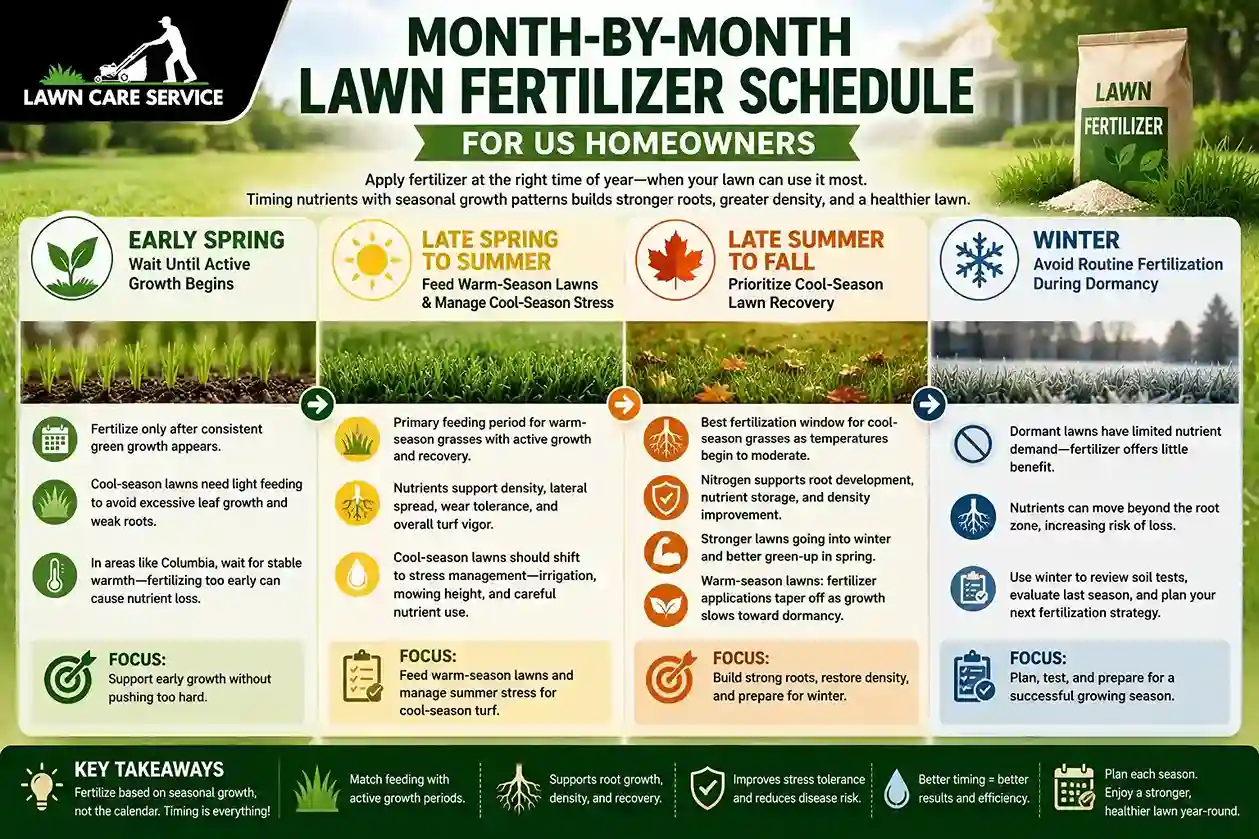
Once the grass type is identified, fertilizer timing should be aligned with seasonal growth patterns. The goal is not to fertilize every season equally, but to apply nutrients when the lawn can actively use them for root development, density, and recovery.
Early Spring: Wait Until Active Growth Begins
One of the most common mistakes is applying fertilizer as soon as winter ends. Grass must be actively growing before it can efficiently absorb and utilize nutrients.
For cool-season lawns, early spring fertilization should occur only after consistent green growth appears. Applying nitrogen too early often encourages excessive leaf growth while roots remain relatively underdeveloped. This can create a lawn that looks green initially but becomes more vulnerable to drought and heat stress later in the season.
In Columbia, homeowners often see fluctuating temperatures between late winter and early spring. Fertilizing during temporary warm spells can result in nutrient loss if cooler conditions return and growth slows again.
Late Spring to Summer: Feed Warm-Season Lawns and Manage Cool-Season Stress
Late spring and summer represent the primary feeding period for warm-season grasses. During this stage, turf is actively producing new shoots, expanding laterally, and recovering from traffic damage.
Warm-season lawns benefit from scheduled nutrient applications during active growth because roots and foliage can efficiently convert nutrients into usable energy. Nitrogen supports density, while balanced nutrients contribute to overall turf vigor and stress tolerance.
Cool-season grasses require a different approach during summer. High temperatures often slow growth and place the lawn under environmental stress. Heavy fertilizer applications during this period can increase moisture demand and make turf more susceptible to disease pressure.
The focus for cool-season lawns should shift from growth promotion to stress management through proper irrigation, mowing height adjustments, and careful nutrient use.
Late Summer to Fall: Prioritize Cool-Season Lawn Recovery
Late summer and fall provide the most valuable fertilization window for cool-season grasses. As temperatures moderate, turf begins directing more energy toward root expansion, nutrient storage, and density improvement.
Nitrogen applied during this period supports root development without producing the excessive top growth often seen with heavy spring applications. The result is stronger turf entering winter and improved green-up the following season.
This timing is particularly effective across many areas of Virginia, where cool-season turf commonly experiences summer stress before returning to active growth during fall. Strategic fall fertilization helps restore density lost during hot weather and strengthens the lawn before winter dormancy.
For warm-season lawns, fertilizer applications generally taper off as growth slows and dormancy approaches.
Winter: Avoid Routine Fertilization During Dormancy
Dormant turf has limited nutrient demand because active growth has largely stopped. Applying fertilizer during this period rarely produces meaningful benefits and may increase the risk of nutrient movement beyond the root zone.
Cool-season and warm-season grasses both enter periods of reduced biological activity during colder months. Instead of fertilizing, homeowners should use winter as an opportunity to review soil test results, evaluate lawn performance from the previous season, and prepare a more targeted fertilization strategy for the upcoming growing cycle.
A fertilizer schedule becomes more effective when applications are concentrated around active growth periods rather than distributed evenly throughout the year. Timing nutrients according to seasonal turf activity improves nutrient efficiency and produces more consistent lawn performance.
How Often Should Homeowners Fertilize a Lawn Each Year?
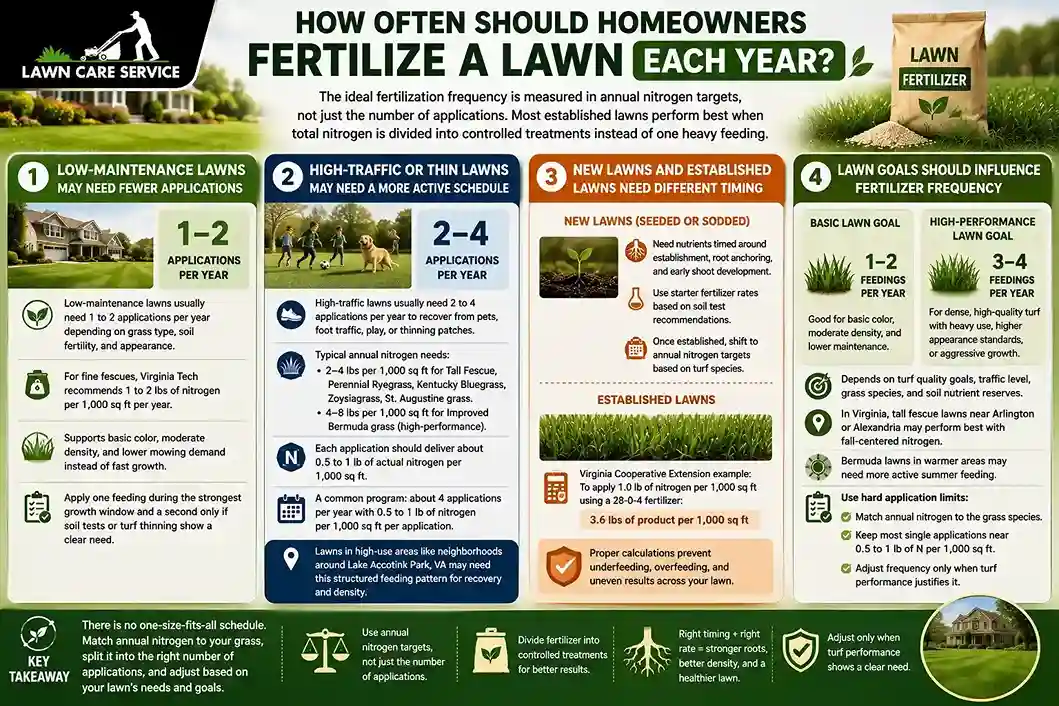
The ideal fertilization frequency should be measured in annual nitrogen targets, not just the number of applications. Most established lawns perform best when total nitrogen is divided into controlled treatments instead of being applied in one heavy feeding.
Low-Maintenance Lawns May Need Fewer Fertilizer Applications
Low-maintenance lawns usually need 1 to 2 fertilizer applications per year, depending on grass type, soil fertility, and expected appearance. For fine fescues, Virginia Tech notes that 1 to 2 pounds of nitrogen per 1,000 square feet per year is often enough.
This approach fits lawns that already have stable coverage and light use. Instead of pushing fast growth, the schedule supports basic color, moderate density, and lower mowing demand.
For a simple program, homeowners may apply one feeding during the strongest growth window and a second only if soil tests or turf thinning show a clear need.
High-Traffic or Thin Lawns May Need a More Active Schedule
High-traffic lawns usually need 2 to 4 fertilizer applications per year, especially when turf must recover from pets, foot traffic, outdoor play, or thinning patches. K-State lists typical annual nitrogen needs at 2 to 4 pounds per 1,000 square feet for tall fescue, perennial ryegrass, improved Kentucky bluegrass, zoysiagrass, and St. Augustine grass.
Improved Bermuda grass can require 4 to 8 pounds per 1,000 square feet per year under higher-performance management.
For active residential yards, each application should usually deliver about 0.5 to 1 pound of actual nitrogen per 1,000 square feet. UC Agriculture and Natural Resources also describes a common lawn program as about 4 applications per year, with 0.5 to 1 pound of nitrogen per 1,000 square feet per application.
Near high-use areas such as neighborhoods around Lake Accotink Park in Virginia, lawns exposed to repeated outdoor activity may need this more structured feeding pattern to support recovery and density.
New Lawns and Established Lawns Need Different Fertilizer Timing
New lawns should not follow the same schedule as mature turf. Newly seeded or sodded lawns need nutrients timed around establishment, root anchoring, and early shoot development.
Starter fertilizer rates should follow soil test recommendations because phosphorus and potassium needs vary sharply by site. Once the lawn is established, the schedule should shift toward annual nitrogen targets based on turf species.
For established lawns, Virginia Cooperative Extension gives a practical calculation method: applying 1.0 pound of nitrogen per 1,000 square feet with a 28-0-4 fertilizer requires 3.6 pounds of product per 1,000 square feet.
That type of calculation prevents underfeeding, overfeeding, and uneven results across the lawn.
Lawn Goals Should Influence Fertilizer Frequency
A basic lawn may only need 1 to 2 annual feedings, while a dense, high-performance lawn may require 3 to 4 scheduled applications within the correct growing season. The difference comes from expected turf quality, traffic level, grass species, and soil nutrient reserves.
Homeowners focused on lawn health and protection in Virginia should avoid treating fertilizer frequency as a fixed package. A tall fescue lawn near Arlington or Alexandria may perform best with fall-centered nitrogen, while a Bermuda lawn in a warmer microclimate may need more active summer feeding.
The most reliable schedule uses hard application limits: match annual nitrogen to the grass species, keep most single applications near 0.5 to 1 pound of nitrogen per 1,000 square feet, and adjust frequency only when turf performance justifies it.
Soil Testing and Fertilizer Type Should Shape the Schedule
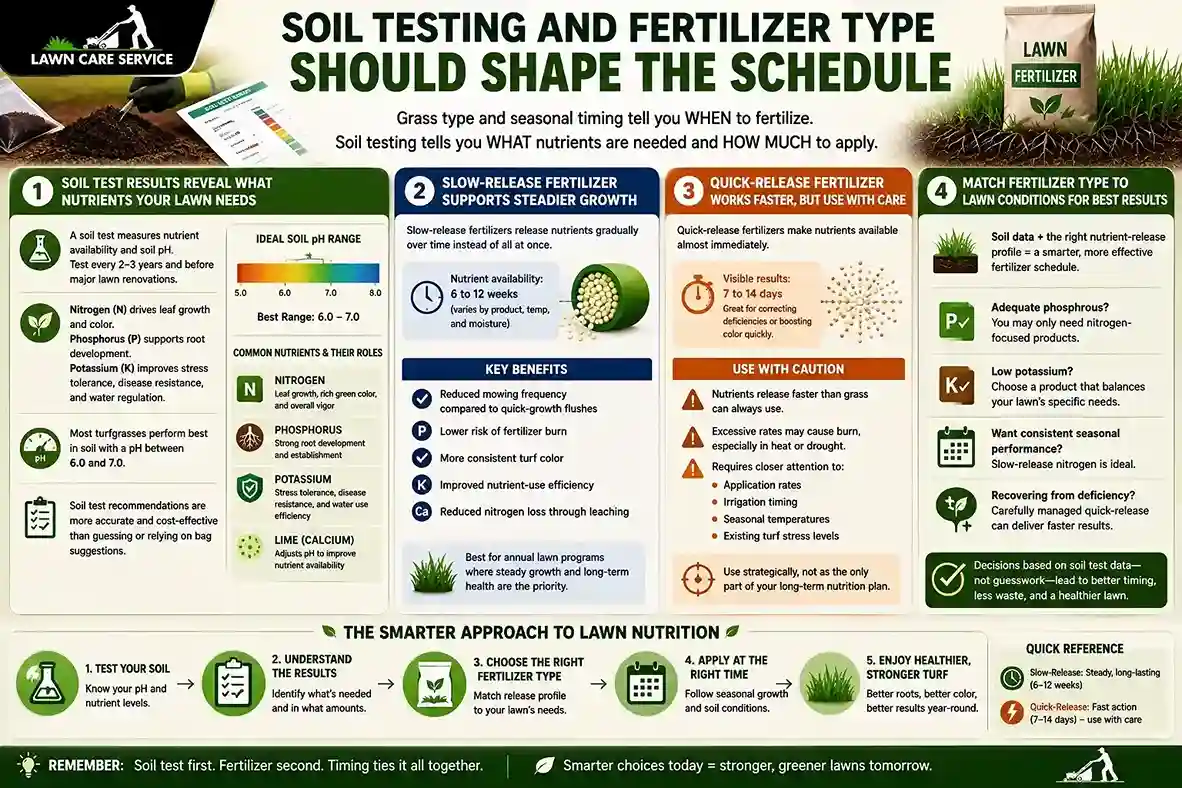
Grass type and seasonal timing determine when fertilizer should be applied. Soil testing determines what nutrients should be applied and how much is actually needed. Without a soil analysis, homeowners are often guessing whether the lawn needs nitrogen, phosphorus, potassium, lime, or no additional nutrients at all.
Soil Test Results Reveal Whether Nitrogen, Phosphorus, Potassium, or Lime Is Needed
A soil test provides a baseline measurement of nutrient availability and soil pH. Most university extension programs recommend testing every 2 to 3 years for established lawns and before major lawn renovations.
Nitrogen drives leaf growth and color, but phosphorus supports root development while potassium contributes to stress tolerance, disease resistance, and water regulation. Applying nutrients that already exist in sufficient quantities increases cost without improving turf performance.
Soil pH is equally important because nutrient availability changes as pH moves outside the optimal range. Most turfgrasses perform best in soil with a pH between 6.0 and 7.0. Even a properly fertilized lawn can struggle if nutrients become unavailable due to pH imbalance.
For this reason, fertilizer recommendations generated from a soil test are usually more accurate than relying on a standard bag recommendation.
Slow-Release Fertilizer Supports Steadier Lawn Growth
Slow-release fertilizers are designed to supply nutrients gradually over time instead of delivering most of the nitrogen immediately after application.
Many controlled-release products provide nutrient availability for approximately 6 to 12 weeks, depending on formulation, temperature, and moisture conditions. This extended-release pattern creates more consistent growth and reduces the sharp flushes that often occur after quick-release applications.
Additional advantages include:
- Reduced mowing frequency compared with aggressive quick-growth responses
- Lower risk of fertilizer burn
- More consistent turf color
- Improved nutrient-use efficiency
- Reduced nitrogen loss through leaching
Slow-release products are commonly used in annual lawn programs where maintaining stable growth is a higher priority than producing rapid visual results.
Quick-Release Fertilizer Works Faster but Requires More Caution
Quick-release fertilizers make nutrients available almost immediately after application. Visible turf response can often occur within 7 to 14 days, making these products useful when correcting nutrient deficiencies or improving color quickly.
The trade-off is that nutrients become available faster than the grass can always utilize them efficiently. Excessive application rates may increase burn risk, especially during warm weather or drought conditions.
Quick-release products generally require closer attention to:
- Application rates
- Irrigation timing
- Seasonal temperatures
- Existing turf stress levels
Because nutrients are released rapidly, these fertilizers are often used strategically rather than as the sole component of a long-term lawn nutrition program.
Matching Fertilizer Type to Lawn Conditions Produces Better Results
The most effective fertilizer schedule combines soil data with the appropriate nutrient-release profile. A lawn with adequate phosphorus levels may only require nitrogen-focused products, while a potassium-deficient lawn may benefit from a different nutrient balance altogether.
Similarly, a homeowner seeking consistent seasonal performance may benefit from slow-release nitrogen, while a lawn recovering from nutrient deficiency may respond better to a carefully managed quick-release application.
When fertilizer selection is guided by measured soil conditions instead of assumptions, application timing becomes more effective, nutrient waste decreases, and long-term turf performance becomes easier to maintain.
Common Fertilizer Timing Mistakes Homeowners Should Avoid
Even a well-planned fertilizer schedule can produce disappointing results if nutrients are applied at the wrong time. Most lawn fertilization problems stem from poor timing rather than poor products.
- Applying fertilizer before active growth begins: Grass absorbs nutrients most efficiently during active growth periods. Fertilizing dormant or barely active turf often reduces nutrient utilization and increases the chance of nutrient loss.
- Feeding cool-season lawns during peak summer heat: High temperatures place cool-season grasses under stress. Heavy nitrogen applications during this period can increase water demand, encourage disease activity, and weaken overall turf performance.
- Fertilizing warm-season grasses too early in spring: Applying fertilizer before complete green-up encourages premature top growth while roots remain relatively inactive, resulting in inefficient nutrient use.
- Using the same schedule every year regardless of weather conditions: Unusual rainfall, drought, prolonged heat, or late cold spells can shift growth patterns. Fertilizer timing should follow turf activity rather than a fixed calendar date.
- Applying excessive nitrogen in a single treatment: Most lawns perform better when annual nitrogen requirements are divided into multiple applications. Heavy feedings often create rapid growth surges, increased mowing demands, and weaker stress tolerance.
How to Build the Right Fertilizer Schedule for Your Own Lawn
The most effective fertilizer schedule is customized to the lawn rather than copied from a generic online calendar. A simple decision framework can help homeowners create a more accurate plan.
- Identify the primary grass species first: Determine whether the lawn is dominated by cool-season or warm-season turf. This decision establishes the foundation for all seasonal timing recommendations.
- Use soil test data to guide nutrient selection: Apply nutrients based on measured deficiencies instead of assuming the lawn needs a complete fertilizer blend every year.
- Calculate annual nitrogen requirements: Match total yearly nitrogen to the grass species and lawn goals. Low-maintenance lawns generally need less nitrogen than high-traffic or premium-appearance lawns.
- Schedule applications around active growth periods: Fertilizer should support periods when roots and shoots are actively developing, not when the lawn is dormant or under significant environmental stress.
- Adjust based on lawn performance: Thinning, discoloration, poor recovery, excessive growth, or strong performance all provide feedback that can help refine future fertilizer schedules.
- Review the schedule annually: Changes in weather patterns, soil conditions, irrigation practices, and lawn usage may require adjustments from one season to the next.
A successful lawn fertilizer schedule is ultimately built on four factors: grass type, seasonal growth timing, soil conditions, and realistic lawn performance goals. When those factors align, fertilization becomes more efficient and produces more consistent long-term results.
A healthier, greener lawn starts with the right fertilizer schedule, but timing, nutrient selection, and local growing conditions can make all the difference. If you’re looking for expert guidance tailored to your lawn’s specific needs, Lawn Care Service can help create a customized fertilization plan that supports stronger roots, consistent growth, and year-round curb appeal.